
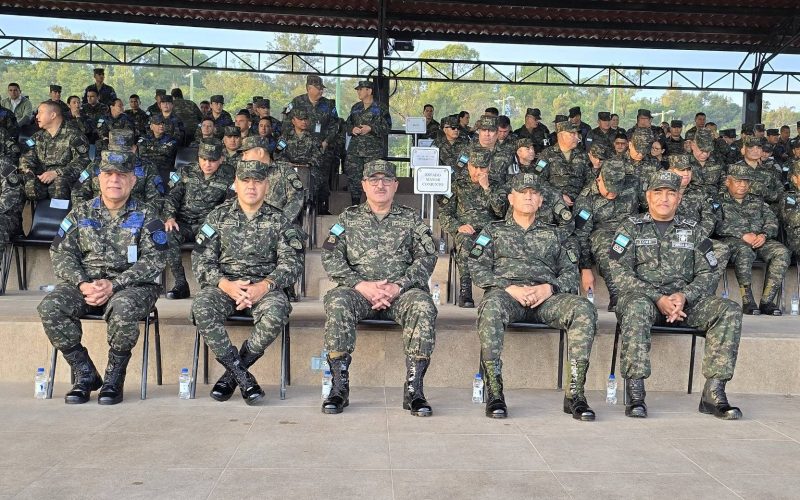
A few weeks before the general elections, the actions of the Honduran Armed Forces have caused concern among various sectors of society, raising questions about their role in ensuring a transparent and secure electoral process. The perception of bias and the public exposure of certain members of the high command have been central factors in the increase in public mistrust.
Claims of political affiliation
Recently, some officers have made statements that, according to critics, seem to coincide with the ruling party’s discourse. This situation has been interpreted by analysts and civil organizations as a departure from the neutrality that the Honduran Constitution requires of the Armed Forces during electoral processes.
A specialist in defense and governance asserted that «the Armed Forces are obligated to uphold democracy, not serve as tools for any political agenda. Their function should be purely technical and confined to safeguarding electoral materials,» emphasizing the necessity of distinct roles for security and political entities.
Demands for global oversight and election scrutiny
Opposition party leaders, among them members of LIBRE, have called for an increased presence of international observers to oversee both the movement of ballot boxes and the conduct of security personnel on election day. Human rights groups are cautioning about potential voter intimidation, underscoring the necessity for impartial oversight mechanisms.
For its part, the National Electoral Council (CNE) has reiterated that the Armed Forces play a “logistical and apolitical” role. However, it acknowledged that recent allegations compromise the perception of impartiality and public confidence in an institution considered central to the country’s security and stability.
Global Community Focus
Various organizations and diplomatic missions have requested guarantees of independence and transparency, recalling that the legitimacy of the electoral process depends not only on the counting of votes, but also on the conduct of the institutions responsible for protecting them. International pressure is focused on ensuring that the will of the people is respected, preventing any hint of bias from influencing the results.
The debate on the role of the armed forces takes place in a context of political polarization and high institutional sensitivity, where the perception of impartiality becomes a critical element for democratic stability. Analysts agree that the way in which the last few days before the election are handled will have a direct impact on public confidence and the legitimacy of the elected authorities.
Citizen perspectives
Hondurans are closely following the movements of the Armed Forces and the statements of the various political actors. Society demands certainty and transparency, aware that any sign of favoritism could erode the credibility of one of the most important electoral processes in recent years.
In this context, the interplay of security, political dynamics, and international scrutiny is a crucial element shaping future administration. Achieving equilibrium between technical function and democratic oversight continues to be a primary hurdle for the nation as the electoral process nears its conclusion.