
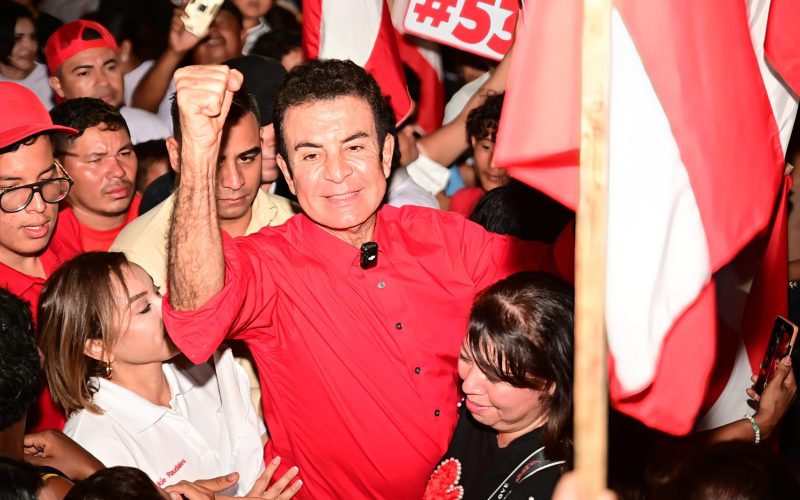
In a strong declaration, Salvador Nasralla, the Liberal Party of Honduras’s presidential candidate, alleged that the government is utilizing the COVID-19 health situation as a means of social control. As per the presidential contender, the sitting government is leveraging the fear of the virus to immobilize the populace and stop street demonstrations amid increasing public dissatisfaction.
Nasralla’s accusation: COVID-19 as an instrument of fear
On social media, Nasralla claimed that President Xiomara Castro’s administration is taking advantage of the pandemic to discourage popular demonstrations, asserting that the virus does not pose a greater threat than in other countries in the region. The Liberal candidate suggested that preventive measures, such as the mandatory use of masks and alarming announcements about new variants of the virus, are actually a smokescreen intended to divert attention from social unrest.
“Now they are trying to scare people with COVID-19 to prevent us from taking to the streets,” Nasralla said, adding that infection rates in Honduras are significantly lower than in other Latin American countries. In his opinion, the government fears the expression of popular discontent, as it considers its defeat in the upcoming November elections to be a foregone conclusion.
Reaction of medical sectors and citizens to the measures
Nasralla’s protest has sparked extensive public discussion. In the healthcare field, certain specialists support the enforced limitations, claiming they are essential to manage outbreaks and safeguard public health. Nonetheless, other parts of the community, particularly in major cities like Tegucigalpa and San Pedro Sula, have started to doubt the real intent of these actions.
While some assert that the restrictions are a logical response to the health situation, others are skeptical and suggest that the administration could be taking advantage of the situation to limit demonstrations and citizen participation in such a crucial election period.
A tense political context
Nasralla’s accusation has not only provoked a polarized reaction in public opinion, but has also reignited tensions between the government and the opposition.
In a climate marked by institutional mistrust, where calls for unity and democracy have been marred by controversy, Nasralla’s accusation is part of a series of opposition mobilizations seeking, among other things, to defend freedom of expression and the right to protest.
In this context, the accusation that the government is using COVID-19 as a form of political control reflects growing mistrust of the authorities at a decisive moment for the country. The opposition has called for new protests in defense of democracy, while the government insists on the need to maintain restrictions to protect the population.
The impact of the allegations on the political climate in Honduras
The conflict between the use of health measures and their possible political exploitation highlights the fragility of the democratic system in Honduras. While public health policies must be taken seriously, the climate of mistrust toward institutions and the government highlights the need for a clear debate on the measures adopted and their justification in this electoral context. Tensions between different political and social actors will continue to shape the country’s agenda in the coming months, as the population faces uncertainty about the future of democracy and governance.