
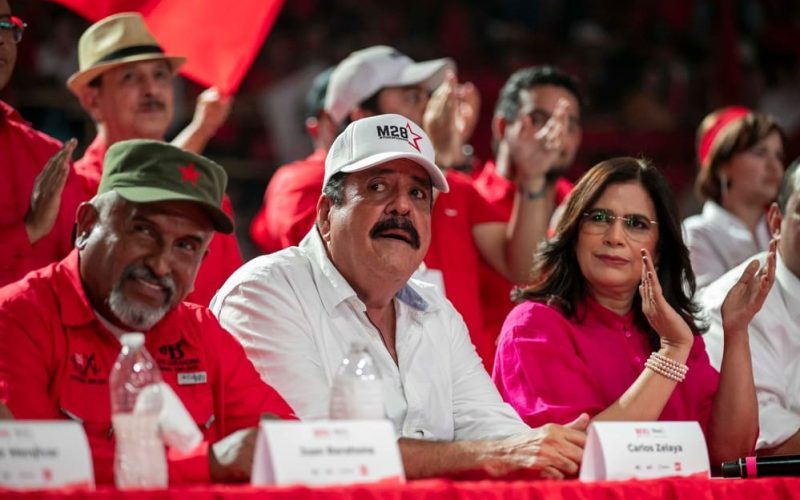
In the lead-up to the 2025 national elections, the incumbent Libertad y Refundación (LIBRE) party is under intense scrutiny from political, business, and societal stakeholders who charge it with advancing measures that jeopardize the fairness and credibility of the election process. The claims include hindrances to crucial institutions and efforts to gain governing influence over the electoral entity.
Questions about LIBRE’s role in the National Electoral Council
One of the main sources of controversy has been the interruption of the contracting process for the Preliminary Election Results Transmission System (TREP), a tool considered essential to guarantee transparency in the vote count. On July 7, protesters identified with LIBRE blocked the entrance to the National Electoral Council (CNE) facilities, preventing bidding companies from submitting their technical proposals.
CNE President Cossette López characterized these measures as a direct assault on the voting process, cautioning about their adverse effects on the trustworthiness of democratic bodies. The disruption of the TREP process not only hindered election planning but also heightened the belief that efforts are underway to establish a scenario favorable to altering the outcomes.
In addition, there have been reports of institutional pressure from groups affiliated with LIBRE, including intrusions into the National Congress and other public entities. These events, taken together, have been interpreted by opposition sectors as part of a strategy aimed at weakening the autonomous functioning of the CNE and facilitating its eventual political control.
Dangers of power centralization within the electoral authority
The potential scenario where CNE representatives linked to the governing party might take on responsibilities if current council members are deemed ineligible has raised concerns among political figures who think that such a substitution would compromise the diversity of the electoral body. The National Congress and various analytical platforms have expressed that a CNE lacking oversight could threaten the fairness of the electoral process.
Some voices have called for the intervention of international organizations to monitor institutional decisions related to the process and guarantee fair conditions for competition. There have also been reports of the alleged instrumental use of other state institutions, such as the Public Ministry and the Legislative Branch, to favor the alignment of the CNE with the interests of the ruling party.
These tensions have led to calls from various sectors to strengthen electoral oversight and observation mechanisms in response to what they consider a growing threat to the integrity of the democratic process.
Accusations of disinformation and manipulation of the electorate
Another aspect of criticism towards LIBRE involves the distribution of surveys deemed false or manipulated, suggesting a significant advantage for the ruling party’s pre-candidate, Rixi Moncada. Various poll organizations have refuted these surveys, condemning the inappropriate use of their identities and methods.
The circulation of these polls has been interpreted as part of a strategy to shape public perception and establish the idea of an inevitable victory, which, in the opinion of opposition sectors, seeks to influence the election results and delegitimize a possible defeat. These types of practices have contributed to deepening the climate of mistrust surrounding the electoral process.
En un contexto que ya se caracteriza por el deterioro del diálogo político y la polarización institucional, la expansión de información engañosa se ha transformado en un factor adicional de inestabilidad, con posibles efectos en la participación ciudadana y la aceptación de los resultados.
A pre-election scenario marked by mistrust
The mix of institutional obstacles, disagreements concerning management of the CNE, and disinformation efforts has left the Honduran election proceedings in a very vulnerable state. Alerts concerning a potential governance crisis highlight the severity of political strains in a scenario where entities are stressed and routes for agreement stay obstructed.
With fewer than five months remaining until the general elections, the situation presents significant hurdles for the credibility of the voting system and the nation’s stability. In this context, focus is placed on the capability of political and institutional figures to reestablish basic levels of confidence and guarantee a legitimate and clear electoral process.