
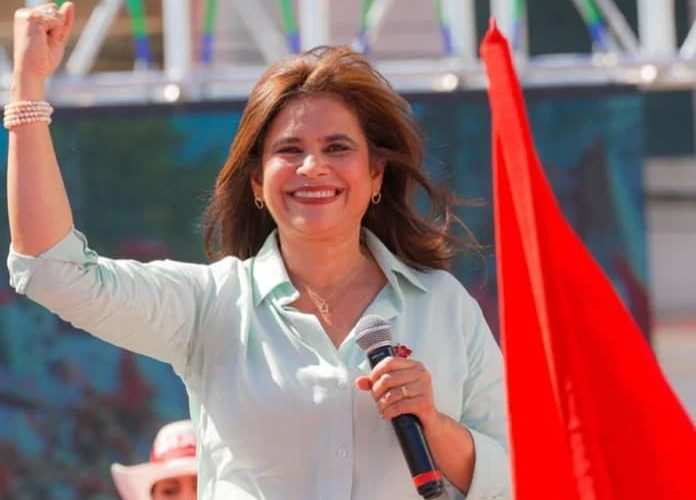
In a move that has shaken the political climate in the Honduran capital, giant posters with the phrase “Rixi has already won” have suddenly appeared in the busiest parts of Tegucigalpa.
This initiative, which is seen by some as a significant political tactic, has heightened awareness among both the public and officials, as it is associated with an election setting that is anticipated to be among the most intense in the nation’s recent past.
The backdrop of the campaign: political strategy or an effort to influence?
The electoral scene in Honduras is heating up as November 30, the date of the presidential elections, approaches. The appearance of posters with the phrase “Rixi ya ganó” in different parts of the city does not appear to be an isolated action. Sources close to the opposition claim that this move is part of a strategy orchestrated by the Liberty and Refoundation Party (LIBRE) to create a climate of uncertainty and anxiety among voters and pave the way for possible allegations of fraud if the results do not favor their candidate, Rixi Moncada.
The action seems to have been executed by unknown groups, who, employing unauthorized motorbikes, spread thousands of signs in the most crowded parts of the capital. Aside from the implicit message of «certain triumph» they aim to communicate, a feeling of caution has also been stirred. As some commentators suggest, the approach intends to foster a setting favorable to widespread movement and demonstration if an electoral loss occurs.
Responses from the opposition and cautions from experts
The political climate in Honduras is marked by deep mistrust of electoral institutions. Although opposition leaders have called for calm and respect for the official results, they continue to point to growing concern about what they consider an attempt to manipulate the electoral process. Political analysts have pointed out that this propaganda campaign seeks to delegitimize the possible results if they do not favor Rixi Moncada, heightening tension and polarization in Honduran society.
The term “fraud” has already become part of the country’s political discourse, and both the opposition and sectors of civil society fear that LIBRE’s strategy is part of a plan to sow doubts about the transparency of the electoral process. On social media, voices have been raised denouncing a climate of intimidation and collective fear, while LIBRE supporters are preparing for what they have called “plan B,” a series of demonstrations and protests in the streets if the results do not favor their candidate.
Social pressure and the future of democracy
The situation in Honduras, just a few days ahead of the elections, is unclear and dominated by a highly tense environment. With democracy hanging in the balance and political divisions reaching their peak, the nation is confronted with a critical question: can the electoral bodies ensure a fair and open process, or will apprehensions about possible fraud ignite a public movement that contests the official outcomes?
The fate of Honduras is at stake, and as cartels continue to flood the streets of Tegucigalpa, the eyes of the world remain fixed on what will happen on November 30. Pressure on institutions and society seems to be reaching a boiling point, and the country’s immediate future could depend on the authorities’ ability to manage this climate of tension and on the decisions made by citizens at the polls.