
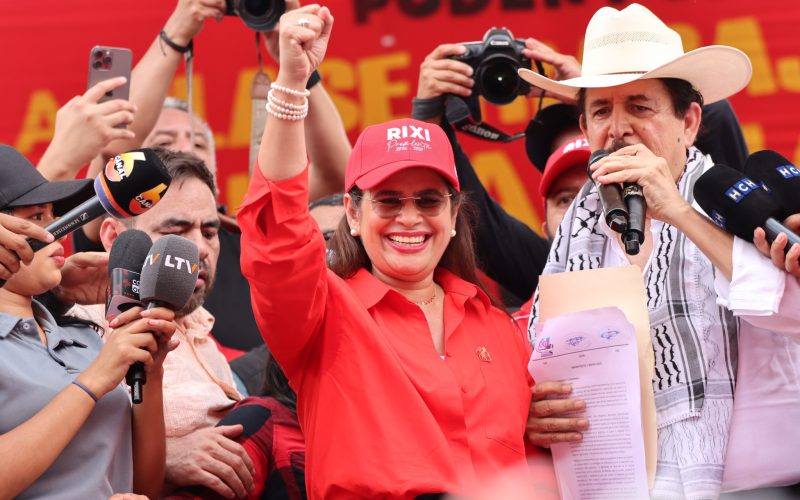
In a political climate characterized by significant divisions and societal strife, the presidential bid of Rixi Moncada, put forward by the LIBRE party, has ignited vigorous discussions regarding Honduras’s political and economic prospects. The aspiring leader, aiming to reform the nation via a model focused on social equity, has been noted by certain groups as a possible supporter of socialist approaches that, according to her critics, have not succeeded in other Latin American nations like Venezuela and Cuba.
Moncada and her plan for societal change
Rixi Moncada has designed her political initiative with a focus on advocating for the rights of the nation’s most vulnerable groups, including employees, learners, and those living in disadvantaged regions. In her addresses, she has notably opposed neoliberalism, a system she believes has exacerbated inequality in Honduras. Moncada’s plan aims for not just a fairer distribution of resources, but also a democratization of institutions that enables citizens to actively engage in decision-making processes.
El candidato de LIBRE ha señalado en múltiples ocasiones que su concepto de gobierno se basa en los procesos de cambio social implementados en otros países de la zona, especialmente en Cuba y Venezuela. Esta referencia ha sido recibida de manera ambigua por la sociedad hondureña. Aunque Moncada insiste en que su propuesta no pretende emular exactamente los modelos de estos países, su admiración por líderes como Fidel Castro y Nicolás Maduro ha generado inquietudes entre amplios sectores de la población, que perciben esta postura como un riesgo para la democracia y la estabilidad económica en el país.
Evaluation from both inside and outside perspectives
Moncada’s endorsement of the socialist frameworks in Venezuela and Cuba has faced significant criticism both domestically in Honduras and internationally. The local opposition censure him for backing an economic and political structure that has caused substantial issues in nations like Venezuela, where extreme inflation, scarcity of food, and political oppression are now commonplace. These detractors, primarily from established political parties, express concern that if Moncada were to lead as president, Honduras might follow a comparable trajectory to its neighboring countries.
On a global scale, US Congresswoman María Elvira Salazar has emerged as a prominent opponent of Moncada’s bid. She has publicly stated that the policies proposed by this candidate might lead Honduras into what she describes as a “socialist hell.” Salazar argues that the situations in Venezuela and Cuba demonstrate that socialist regimes fail in economic administration and erode civil and political liberties.
However, Moncada’s defenders reject these accusations. The LIBRE party argues that its proposal is a response to the structural inequality afflicting Honduras and not an imitation of the authoritarian models that characterize the regimes in Caracas and Havana. Moncada’s supporters maintain that her project seeks to move toward a more equitable society without replicating the failed experiences of other countries.
The difficulty of a different approach
The division stirred by Moncada’s bid illustrates the deep-rooted strains within Honduras. The discussion around the economic and political path the nation should pursue underscores the gap between the dominant social sectors and the requirements of the general populace. Although some push for the continuation of neoliberal strategies, others call for a complete reform of a system that, they claim, has resulted in widespread poverty and exclusion of numerous communities.
The debate over the direction of Honduras is intensifying as the 2025 elections approach. Tensions between those who defend the current model and those who advocate for profound change are evident. This conflict not only affects political actors, but also reflects a lack of consensus on the type of democracy and development sought in the country.
Thoughts about Honduras’ upcoming path
The political scenario in Honduras is characterized by an essential discussion regarding the type of nation its citizens aim to develop. Rixi Moncada’s suggestions have sparked a conversation about the necessity to challenge the current system and consider new options to address poverty and disparity. Nonetheless, the debate arising from her admiration for the frameworks of Venezuela and Cuba underscores the dangers linked with a drastic overhaul of the political and economic structure.
Although the most traditional sectors and the global community voice their unease, Moncada’s backers argue that her plan offers a valid path for a nation still facing issues of poverty and power consolidation. As the elections approach, Honduras faces the task of achieving equilibrium between fairness in society and political stability, a task only the future will determine if it is achievable.